
Christmas 2A | Matthew 2:1-12
On the eve of Christmas, we gathered to sing and celebrate the birth of Jesus, the incarnate one, the hoped-for king. He was born of a virgin, protected by her fiancé, to be the true parents of the messiah. We gathered and we heard the good news and proclaimed joy to the world. For many of us, it is the best night of the year.
We heard a story of the couple traveling to Bethlehem to be counted, seeking a place to rest, and the baby being born, placed in a feeding trough to double as a crib. It is a recognizable story, pastoral and memorable. Humble, yet joyous. And then an angel appeared to shepherds keeping watch in the fields. Laborers who work nights. Working class heroes, watching, protecting the sheep when God came into the world.
Shepherding isn’t a glamorous job. It’s dirty and thankless. Jewish shepherds lived outside with their sheep in a constant state of ritual impurity. This is emotionally and spiritually painful work. Which is why it was often forced labor, done by prisoners and indentured servants. Not the sort of people parents usually want around their newborn. Around the future king.
No purity in that room that night. Just grace and truth.
The Wise Men
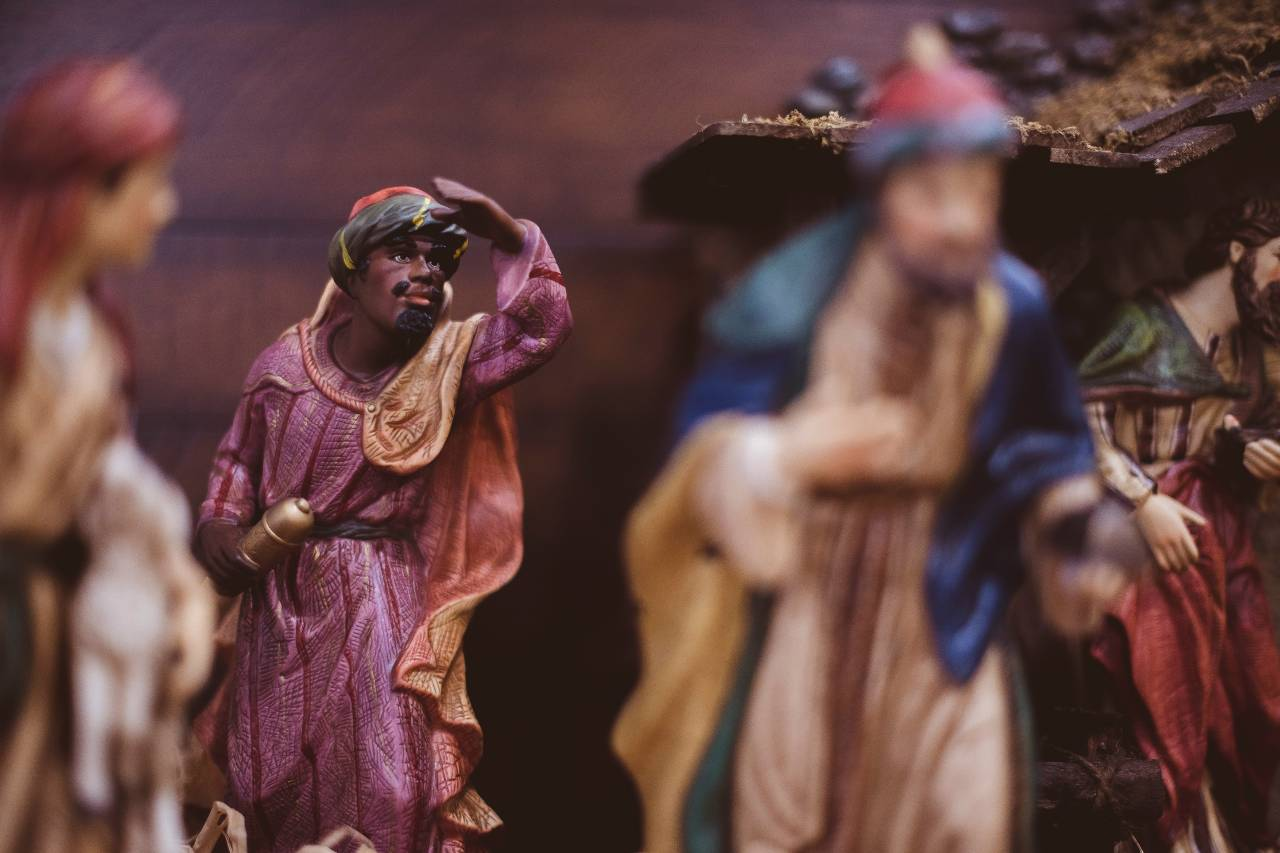
We move to Matthew’s gospel, to a later time in the story, when some star watchers, eastern astrologers, probably from Persia, are moved to travel west. They had a vision. A curious vision. And a star that just seemed to appear in the sky, mesmerizing, like a voice whispering “follow me.”
These travellers are often called kings, but they weren’t. And the text doesn’t number them or name them either, but we have tradition filling in the gap. Three gifts, three wise men to give them, each carrying a box — delightful symmetry.
These men are drawn by a promise, like the shepherds. A dawning of a new era. Freedom and love and for once, hope. We get why the shepherds arrive, right? Because the promise of freedom is enticing — from within that closed world. But these travellers aren’t from there. This isn’t their tradition. The baby won’t be their king.
And yet . . . they are drawn. Curious, isn’t it? They are drawn and they want to go and see and pay homage. These aren’t visiting dignitaries — we need to remember this — but are drawn to this foreign land to someone who could be their own. Who could mean something to the whole world — not just the nobodies in Judea.
And as they get closer, they stop trusting the star, the vision. They stop themselves from being led to the king, the incarnate one. They stop trusting the God they didn’t even know they were following. And instead, they rely on the human tradition of power, order, and certainty.
The Mistake
It is so normal we probably don’t notice it any more than they do. That turn, when they move from trust to tradition.
They arrive in Judea, probably from the north of the Dead Sea, along the trade routes. And they would naturally go through Jerusalem on their way to Bethlehem, just nine kilometers south, about five and a half miles. Like the distance from here to Rose Hulman or Meijer on 46. Not far. David’s city is so close. I suppose star-following is imprecise. And besides, they aren’t from around here, are they? The star probably looked overhead when they arrived, and they assumed —
It is a safe assumption, right? This star, above the capital city, above the existing throne, that these might relate, right? It seems like a natural leap. That has to be why they do it. They don’t know Herod and his murderous jealousy, his madness, that a genuine psychopath would be on the throne, ruling over God’s chosen people.
So they ask around. Maybe the locals know something. And word gets to the mad king, who calls them in, to hire them, right? Just do a little recon and come back. We want to honor him, too! And when the wise men realize their mistake, it is too late. They’ve said too much.
Like Moses
Like the shepherds, these travellers pay homage to the newborn king. The hope for the world.
A hope that is contrasted by their own experience of fear. Of complicity. And they flee. A bit of the ol’ not-my-monkees-not-my-circus. They high-tail it back to Persia and wash their hands of the events that transpired.
And an angel visits Joseph again — another message, like the one to protect Mary — and he is told to protect Mary and Jesus. To flee, too. Flee to Egypt. Flee to the land God told the Hebrew people never to return to. Herod wouldn’t look there. Save the boy, like the Levite woman who sent her son down the river in Egypt to protect him from the new mad pharaoh. A boy who would be rescued and given an Egyptian name, Moses, and raised in the Pharaoh’s home. A parallel refuge.
And another mad king, like that mad Pharaoh, would genocide a generation — only the boys, of course. Slaughter them to protect his empire, like Sith Lords.
The Holy Family live as refugees in Egypt until the reign of terror is over. And even then, when they return, they don’t go home. They head to the north, to a backwoods town in Nazareth. Where they can live as nobodies. Like shepherds.
Our Place
The place of power and the peasants yearning for peace is inescapably present here. Though the pastoral images are intoxicatingly joyous, and the menacing specter of empire’s murderous rage is easy to illude during the season, like a Christmas chase. But the story, the whole story, keeps this all ever present. That shepherds rejoice and kings fear the birth of Jesus. When prophets proclaim and Mother Mary sing, we too should rejoice as shepherds, peasants, the people longing for Christ’s promised peace.
This is for us. Not for might, or power — our own supremacy — but to draw such evil out of our world. So we might all be free of it. So that we all might live and love and be the children of God.
We’ll take this and run with it on Epiphany. That’s when we turn to what Jesus means to the world, not just the Hebrew people. Not just the people living on this small bit of land north of Egypt or in a city we still refer to as holy. For today, our focus is on our story — on the incarnation and the impact on our faith. On the people. Who we are to be.
And we are far more like shepherds and carpenters and innkeepers than we are like kings. There are so few of those in the world. And there are literally billions more of us.
In Vulnerability
God’s message of love came in vulnerability to the vulnerable people in the most vulnerable part of our population. He was born in insecurity to people who had so little to give in terms of cultural resources — the value structure of the powerful — but had so much to give in love and so much to give in faith and trust. And in wisdom about the ways of power and its inevitable corrupting will to cause madness in fearful men.
Listen to what Mary says and consider what Joseph does. These are our people. In Jesus they are our parents too. Acting out of love. And like the curiously devoted shepherds and those star watchers, we travel, perhaps metaphorically or spiritually, and yes, physically, too! We travel from where we were to see the incarnate one. To find God in our midst. Humble, vulnerable. And it is we who are here this morning. To rejoice! To shower him with our meager gifts. In homage and affection. With joy and hope for what may yet still be.
May our vulnerability be our truest gift. To God and all of creation.