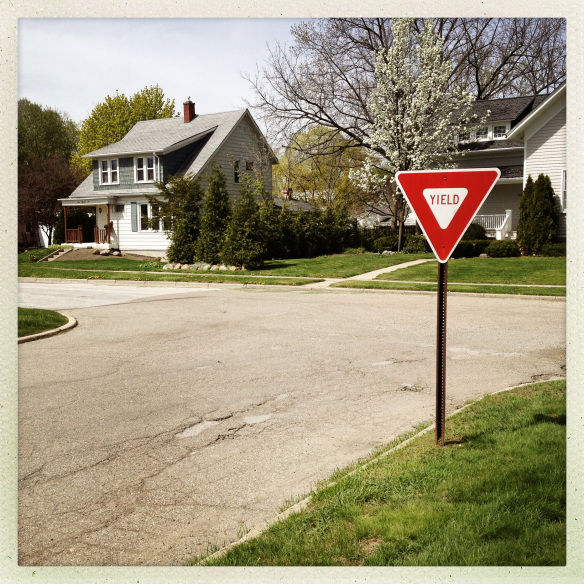
The Right of Way

photo (11)

Dropping my daughter off at preschool this morning, I almost got hit by a car.

I exaggerated. I did not almost. I could have. Here’s how.

My daughter’s preschool is part of a big Lutheran church. They have a good-sized parking lot. We are pretty early and there are relatively few cars. As I walk back to my car in the second row, a red minivan pulls into the first row, right where I am walking. The driver doesn’t stop…she inches. It is clear that she wants me to move over.

To the empty space on my left.

Now, we have dozens of small interactions like this on a daily basis, and most of the time, we just move over. And I’ve preached enough homilies about the kind of forgiving love that doesn’t pay any mind to this. However,

She pissed me right off.

And I hope to be forgiven for the evil thoughts I had. The most obvious among them was how I imposed my thoughts of her true character: the perceived laziness of needing the front-most spot, to the point of expecting a pedestrian to vacate it. When I get back to the car, I discover my wife has had many run-ins with this woman. Apparently she isn’t friendly. Of course, I feel better about those evil thoughts.

And man, that is so not how that is supposed to go.

What really made me mad, wasn’t what I thought about her character or the stuff I imposed upon her. Not really. That’s all surface stuff. It is that she flouted the rules of social behavior without any real value gained for doing so. She was one spot closer to the door, and I had to move to make that happen. As a pedestrian, and particularly, as one whose direction was established, it is my right of way.

When two people come to a door, it is the first one there, with the momentum, that has the right to go through first. Going down the hall, it is the one going straight, not the one turning that has the right of way. We figure this stuff out really early on in life.

My right of way was violated.

Like my friend, who I visited last night. She was nearly hit by a car. And not in my hyperbolic way. A driver not paying attention. A driver who thought her way was right. Actions that had repercussions for my friend.

I was taught in driver’s ed that pedestrians have the right of way. I always presumed it was both the need for safety of pedestrians and the relative un-nimbleness of a car that meant that cars should be the more cautious ones.

In my life, this understanding was questioned. In part by those seeking to highlight personal responsibility for other people. One experience in particular stands out. A representative of the city came to speak at my liberal arts college about city matters. Many students brought up safety concerns regarding the street that bisected campus, with an interest in a traffic light or some other means of slowing down the traffic and protecting the students crossing the street. He not only balked at the idea but suggested that pedestrians don’t have the right of way. I had a certain clarity of response that only a 19 year-old can have. I realized that the city cared more for the complaints of the “townies” and traffic flow than the safety of the students. They needed to be responsible for themselves while the city could be responsible for the drivers’ welfare.

This wasn’t always the case. Check out this story from 99% Invisible, “The Modern Moloch”. It is a story about how our traffic patterns have been formed, quite differently than we might expect, and for different reasons. If you aren’t a regular listener to the 99% Invisible show or podcast, do yourself a favor and subscribe to it through iTunes. You will be glad you did.

The battle over the right of way is a test of will and an expression of dominance. Even the act of yielding, as in assisting another, may be such an expression. But at its core is the question of how one sees the outside world and everything in it. Are we selfish and aggressive or are we communal and compassionate?

At the risk of sounding selfish, I’m just tired of tragedy and selfishness. I’m worn out from the caring and concern. I can see why the Pharisees love their rules. It is so easy to be selfish. But dammit, we need to be better than this.

David Henson on Marriage

As I prepare this week’s Eating Scripture, I read this piece on this week’s gospel by David R. Henson:

Just Marriage: Jesus, Divorce and the Vulnerable.

Do yourself a favor and read it.

Banned by TED

It is interesting how easy it is to get banned. In big language, we would say one only needs to question the dominant paradigm. In plain language, we’d say you just need to upset the apple cart.

Another way to get banned is by speaking as if you are taking a “side” in a popular “debate” about a political hot-button “issue”. This is clearly the case in Nick Hanauer’s TED talk from May.

Except that it isn’t. He isn’t taking a “side”. He is dealing with the reality.

We eagerly suspend the primary function of conversation: that we are rooting out truth collaboratively: while ascribing to people a static position. This undermines the very notion of discovery, critical thinking, and problem solving because it intentionally obscures truth behind a false dichotomy.

As Hanauer goes through the data, he disproves the primary argument batted back and forth among the media elites about the relationship between taxes and jobs. It is an argument that is so easily proven false through not only data, but our own experience of the last thirty years, and Hanauer disproves it so quickly, that there should be nothing the least bit controversial about it.

Oh! But it just so happens to be an argument put forth by progressives and even some Democratic lawmakers. Therefore, it must be classified as “political” and therefore “too controversial” to go up on the TED website. Until a controversy about avoiding controversy developed so they put it online after all.

from a Facebook post shared by The Pragmatic Progressive Page

The problem is that the “issue” is being used to obscure more than just the reality of one 6 minute talk about how jobs are really created. It is used to obscure the very arrangement of the media’s role in obscuring truth. This talk demonstrates the overall preference for maintaining the existing conflict between the Left and Right over the discerning of truth.

So what do we do about it?

When the dominant paradigm is as easily proven false as this one about lower taxes leading to job growth is, we are left with the opportunity to create something new–not a new paradigm, at least not yet anyway–but new conversation, new structures, and new goals for the policies effected by this. In this case, when the apple cart is upturned, we are obligated to figure out a way forward. And there is no room there for political BS.

Perhaps this is the biggest fear of the media elites. Because they have no interest in collaboration or conversation, but in conflict and discord. When we collaborate, it makes it hard to ascribe existing static positions on the participants, because those helping gather the apples, and prepare a new cart aren’t so easily divided and categorized.

I disagree with the usual rhetoric about becoming post-partisan or pursuing a rise in moderates. I also disagree with the common thinking that consequences must be removed from the table so that people aren’t punished for doing the right thing. The real step is to get the media, and this includes the leaders of TED, to recognize the clear difference between “controversial” and “honest”.  A true conversation about solving our crises doesn’t require the elimination of crises so that we can sit down and solve what no longer exists. It needs honesty and openness.

We need to be able to make fixing the obvious crisis with a positive solution the priority. This only happens when the people and our media make it our priority. It should surprise no one when it suddenly becomes lawmaker priority.

Shouldn’t the honest conversation be more important than ascribing easily definable positions to its participants?

There is More Than Supply and Demand

Robert Reich

Robert Reich (Photo credit: victoriabernal)

One of my pet peeves is false dichotamies. You know, when we make complex problems into simple either/or solutions. Like politics. That’s why Robert Reich’s recent column struck me this morning as I read it. He was talking about what the U.S. could learn from the European economic crisis, which is a telling case of what not to do. But he wrote these significant words:

In truth, the choice isn’t simply between budget-cutting austerity, on the one hand, and growth and jobs on the other.

It’s really a question of timing. And it’s the same issue on this side of the pond. If government slices spending too early, when unemployment is high and growth is slowing, it makes the debt situation far worse.

What supply-siders like to suggest is it really is entirely about the dichotomy. That the economics boils down to the simple equation of supply vs. demand. The same goes for an economic crisis: you either cut or increase spending, as if these are the only metrics. In this case, cutting almost always sounds better than increasing, so their side sounds good. But as Reich points out, one unaccounted for variable is timing. As in when things happen.

If we pretend timing has nothing to do with it or perhaps the actual pain caused by austerity measures on actual people has nothing to do with it, we can make seemingly easy decisions. Many times in my own life have I or my wife had to look at the timing of our bills and the timing of our paydays, so don’t dare tell me timing doesn’t matter.

Or if any student of economics argued in class that cutting is cutting without regard to the economic conditions, s/he would be laughed out of the program. So why should we make our arguments so devoid of context?

Question:
What other areas might we benefit from breaking open a dichotomous stalemate?


The Postmodern Condition: Blame Must Be Shared

I watched a TED Talk a couple weeks ago that included a simple picture. The speaker began talking about distraction, because the picture, like the one I’ve provided below, demonstrated what he meant about distraction.

The original picture was of a Dad at the park and he was playing with his smart phone while the child was playing at the park. The image left a quick and lasting impression. His own narrative did as well.

The problem I instantly had was this: 1) his response to the picture was so modernist and 2) it failed to honor the other half of his comments. Let me explain.

The modernist looks at the above picture and says “I see two people in this picture. One must be the mother and the other must be her child. She is playing with her phone, which must mean she is ignoring her child. Therefore, this is a picture of a mother ignoring her child.” Hopefully you notice all of the assumptions made that bring the modernist to come to a conclusion of judgment.

The postmodernist looks at this picture and says: “There are not two people ‘in’ this picture, but three: the woman, the child, and the picture taker. How do you suppose these three are related? Are they related? Is the picture-taker’s subject of the picture necessarily both people, but is instead the more central figure: the woman? In fact, what you bring to viewing this picture informs what the picture is actually about.”

To be fair, it was me taking a picture of my wife and daughter. And the TED speaker’s assumption in his picture is not far from true in the case of this picture in which both parents are playing with their phones while their child is playing. But this is what struck me instantly: there was an observer there judging and not acting. My brain instantly went there and said “Why aren’t you doing something about it, then?”

The original picture, intended to shame us and encourage us to be present with our children, carried with it that very intention of shame. It was created to shame. This was precipitated by crafting an artistic demonstration of the observer’s disgust. And I wasn’t comfortable with that from the moment I saw it. And this was evidently the presenter’s intention. He wanted the viewers to take responsibility in their lives. But he missed the obvious connection in his own picture.

This picture I took is one of a sequence of pictures I was taking of my wife without her knowledge. She actually was the subject of the picture. There was no shame in my heart in their taking, but love.

The problem I have with that simple, modernist response is that it, by ignoring the presence of the third figure, it ignores their complicity in the action. The observer is caught “documenting evidence” of someone else’s moral failure, judging and condescending the whole way, only to distribute a picture that would come to represent “distraction” itself to thousands of viewers. This is morally troubling and unkind.

I am also trying myself to recognize my own place in a similar moral paradigm with regards to the original picture and talk. My hope is that my readers recognize not an intention on my part to blame or shame at all, but to raise the awareness of how easy it is for us to blame and shame in hiding.

Mostly, the modernist’s way of thinking ignores the fact that the observer takes no positive responsibility to help, but takes on negative responsibility to shame.

The trouble for leaders, people of faith, and for the socially responsible in our postmodern world is to not fall into the trap of pretending we can be neutral observers or that those observing an act are somehow removed from it. Like the person who crosses the street to avoid a mugging, rather than take any steps to stop it or the grandparent that knows her own child is struggling with parenting without lending a hand or a shoulder to cry on, we actually can’t be neutral observers. It’s impossible.

Which means we are responsible for what we observe. We share in the events: the blame and the reward: because we are present: even when we pretend we are not.

How does this change how we relate to our neighbors?

Of Rules and Fairness


In last night’s college basketball game, Michigan State beat Wisconsin in overtime.  What is interesting is the crazy clock controversy that erupted during the game.  The problem?  Two clocks showing two different times and a game tying three-pointer that never was.

Take a look at a news account of it.  What is interesting to me is that the rules tell the refs to use the clock on the backboard, which would normally make things cut and dried.  And that’s how they ruled it.  Sounds right.  The Wisconsin player can see that easier than he can see the scoreboard.  Perfect sense.

Except that the buzzer and the lights went off with the scoreboard, not the backboard clock.  The player is trying to beat the buzzer, which he did.  And he sank the shot.

There is a reason they have rules like this one to follow the one clock over the other.  It settles controversies exactly like this one.  I feel confident that the refs made the right decision and that they followed the right rule.

English: A typical Deutsche Bahn railway stati...

Image via Wikipedia

Except that it doesn’t feel exactly right, does it?  It feels a little hinky.  That player gets the ball, turns, shoots, the ball is out of his hands, the scoreboard lights up, the buzzer goes off and the ball sails through the air majestically to, through, the hoop.  It feels a little like cheating to take that away.  A player doesn’t just have the clock, he has abstract clues like lights and sounds.  Without those, the brain doesn’t really process what is happening.  In this way, the two clocks are less relevant than the lights and sounds being set to the wrong clock.  It feels as if this player followed the rules of the game and was let down by an arbitrary ruling.

What do you think?  Are rules as clear as we think?  What if they are a bit squishier than we take them for?

The New Authority: Trust

Deutsch: Polizeihauptmeister MZ (mit Zulage) a...

Phyllis Tickle, in The Great Emergence, outlines our past, describes our present, and previews our immediate, swirling future into what she calls the Great Emergence.  The book is now over three years old, but as astute as ever.  In it, she tackles the question of authority as I raised in a previous post about the Anglican Communion.  I wrote that the source of our biggest conflicts are around the nature of authority and that, as Tickle suggests, we battle every 500 years or so over the who/where/what/why/how of authority.  Specifically, how do we resolve issues in which  there is no discernible structure or force that has jurisdictional punishment over bad actors?  Or, how do we deal with conflict without either a person or a system that has authority to punish?  My response is simple: our punishment simply matches our source of authority.  We just have trouble seeing it yet.

The specifics of conflict are actually pretty common: the kid that gets away with bullying because he does it online or because she isn’t physically seen by a teacher; the youth that gets away with stealing from his neighbors because his Dad is a police officer; all the way up to the president who simply ignores the law on torture or war powers.  Each is a case of someone who gets away with a crime because there is seemingly no mechanism for curtailing the behavior.

Well, Tickle outlines the last two battles each yielding a new sense of authority that made sense for the age.  With the Great Schism in the 11th Century, the answer of who has authority was to put it in the hands (or the seat) of a single person: the pope.  Therefore one person can be the final judge on all things Christian.  Which was great, until there were more than one person claiming to be the pope.  And the pope didn’t seem to have all of the answers.  Or he had the answers, they were just inconsistent.  So in the 16th Century, through the Great Reformation, authority shifted from a human to a book.  Sola Scriptura! they shouted!  And suddenly all authority rested in an inanimate object.  All of the answers could be found there…until they couldn’t.  Until there were too many ways of reading a “plain reading” of the text.  The great revolution that put the Bible in the hands of individuals, led to the downfall of Scriptural authority, because individuals came to different conclusions without the structure of the church.  The Great Reformation worked almost too well!

How Tickle describes the current age, the beginning of the Great Emergence, is to argue that authority will be found not in a person or in a book, but in the network.  That the collection of people, not as a structure, but as a loosely affiliated network, would come to agreement more organically.  I loved the idea when I read it three years ago, but I haven’t been able to quite see it until now.

The problem is that we are dependent on those other means of authority, institutional structures, individual decision-makers, irrefutable texts, and we lazily understand our own part as imbibing what the smart people say and following along.  But the new sense of authority rests in how we come together and upon that which we can agree.  This is to say, not in ignorant cultural beliefs necessarily, but in active attempts to wrestle with questions and problems.

What this means for my specific question is that these individuals get away with criminal behavior because we collectively allow them to.  We don’t stand up to it, either as individuals or as a group.  We allow others to deal with it (or not).  This isn’t a call for vigilantism, far from it, but collective action. It is us who ignore the bully, relying on teachers and principals to act, rather than step in as a class.  It is us who allow a youth to be protected by his place in society.  It is us who allow a president to carry out heinous acts in our name or perhaps more disgustingly, in the name of freedom.  Our action opportunities are plentiful.

Emergence

Image by hybrid756 via Flickr

It comes down to trust.  Our current behavior demonstrates that we don’t trust the system, we simply rely on it and expect it to function.  Then when it doesn’t, we condemn it.  Sometimes we even argue that the system can’t do it.  And even then we still don’t hold the community responsible for cleaning up the mess.

Perhaps this is why there is so much confusion about the Occupy movement, as it is not about political expediency but method and consensus-building.  The way it functions isn’t just a political tactic, but a vision of new community.  Community without a singular figure-head and decision-maker.  No Scripture to hold up as an idol.  No specific confession to demand adherence to.  No institutional hierarchy that demands allegiance.  It is people standing up and taking care of each other.

And that is also a vision of trust.

Is Honesty Required? Ringer and the Politics of Redemption

I’ve gotten hooked on the CW’s Ringer, a ridiculous show about twins, changing identity, and the attempt to change one’s life.  As TV, it is pure pulp, threads the line, not between plausible and implausible, but between implausible and ludicrous.  However, as study of human chaos and redemption, there is nothing like it on broadcast television. Continue reading

Sometimes They Do Equal 5

I do think that sometimes 1+1=5.  That doesn’t make me crazy.  It means that we ought to account for our own blind spots.  To help me explain, I’ve recruited my own daughter.

1 = 1 + 1

As you can see, she has written an interesting equation on the white board.  She is so proud of it, she wrote it over and over again:

1=1+1

People fall into two camps when they see this: Continue reading