On Baptizing My Son

We often speak of being “off duty” when not at work. We speak of our work days and the double lives of “work me” and “real me”. For the presbyter, there is no such distinction. Or at least there shouldn’t be. The toxic effects of split roles in ministry are numerous. So for clergy, there is no punching of the clock. We are what we are.

There is no work life and home life, but life. And yet there are those things that, for everybody else are entirely separate. This makes those moments when the two collide so strange.

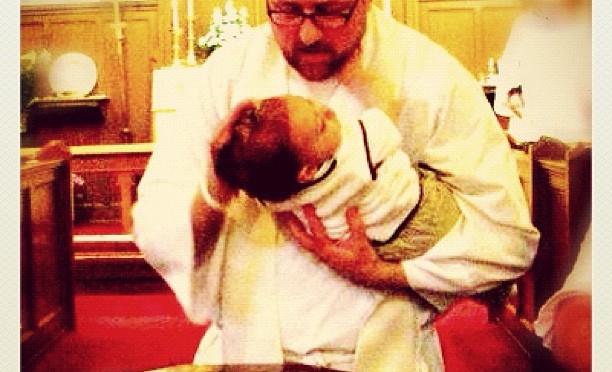
As a presbyter, I have presided over numerous baptisms. Each one has been an honor, particularly the daughter of a good friend. I am able to not only inhabit the office of priest, but be a tangible part of this family’s life. It is powerful stuff.

For the parents, there is the opportunity to be a part of something that can inspire awe in us: to witness transformation! To watch our children become something else, something more.

There are only a few places in which the collision between one’s experience as a parent collides with their pastoral role. Yesterday was one of those.

I was acutely aware of my strange discomfort with wanting this incredibly personal, familial moment of public consequence. I wanted to lift my son up and show him off. I wanted to celebrate this moment with my family, cracking jokes in the pew about the mess we made up front. I wanted to run down the aisle, high-fiving everybody that put their hands out. I wanted to be the proud dad of an incredible son.

I also wanted to be the present and comforting pastor to the other family, whose son I also baptized. I wanted to share the spotlight evenly. I wanted the congregation to bask in the moment and soak in the powerful symbols of water and blessing. I didn’t want this moment to be about me at all, but these two beautiful boys to whom we have vowed spiritual support.

This tension was already on my mind. On Saturday, we celebrated the life of a true saint in our community, John Jones. The nave was packed with people whose lives this one man had impacted. I invited his son, Kevin, to speak on behalf of the family. In many ways, it was like the remembrances we often here at memorial services, but something in this activated something in me. Kevin’s wonderful, earnest description of what his father showed him, what his father did to raise him up moved me to reflect on my relationship with my father, and what I would say about how he raised me.

And then I thought of the office and how presbyters have to split themselves (sort of) or perhaps the more accurate “multitask” these critical moments. I thought of how my father, as a presbyter, baptized both of his children, and then later officiated their weddings. How he led memorial services for his parents. That he has, through the most significant moments in his own life, been both pastor and father/son/husband. Both the office and the person. No wonder he tried to talk me into having someone else officiate at my wedding!

It was in that moment that a simultaneously happy and embarrassing thought entered my mind. I thought

Phew! At least there’s a tradition that when a priest dies, the bishop officiates! I can be a real person.

Then the morbidity of these thoughts pushed me elsewhere.

These are the elements of the season, however: life and death and new life. Baptism isn’t just a bath, but a kind of death: a celebration of the ending of one life and the beginning of another. In many ways, this is the under-girding force of all of our Sacraments. They are about the end of one thing and the beginning of something else. They are death to selfishness and rebirth in revolutionary grace.

For that reason alone, inhabiting the office of presbyter at all of these powerful moments is a shockingly humbling, yet empowering thing. Because none of it is about me except for my own experience within it. And that can be an offering to GOD and to the church. I am so very thankful for this and every opportunity I am given.

Throw Your Process Off a Bridge

It has become clear that we are in an age in which process and system are colliding.

Our institutions aren’t failing because they are institutions (and our government isn’t failing simply because it is government).  They fail because the process is obstructing the system.

What I mean by process and system are simply the difference between rules and the entire legal framework. So the process is the current approach to dealing with aspects of the system.  Process is how you call Waste Management to set up trash collection.  System is municipal trash collection itself.

When Jesus railed against the Pharisees in front of the Pharisees, he attacks their process, and not their system.  He affirms that He loves The Law (System) but hates what they’ve done with it, namely their sub-laws (Process).  His argument is for good Jews to throw the Pharisaical process off the nearest bridge.

The prime evidence for our own problems today is Congress, which according to historians, really is as bad as we think, needing to go back to pre-Civil War era to find such dysfunctional government. This dysfunction, is of course, intentional. As if that makes it any better. The process is being used in a way that seems inconsistent with the system. If you think about it at its most base level, the process (small legal measures) is being used to expressly keep the system (the government) from even fulfilling basic functions, such as paying employees timely, compensating for services rendered, or putting professionals in the jobs for which they are highly qualified.  This is clearly a process problem.

The church and the culture at large are flailing at a time in which we most need both conviction and compassion. It is high time we say “screw it” to the process and start preparing the way for the Kingdom.

Forward living or backward obsessing?

My brain is intent on proving me wrong.

More than a decade ago, when my two closest friends were living in East Lansing, I moved down to join them.  Having only visited the apartment once or twice, and not knowing the area very well, I was confident that I knew the way to get there; however, I wasn’t confident of other ways to get there.  After getting stuck behind a few slow-moving cars, I sped around them, only to find I had misjudged the distance before my turn, so I checked my blind spot and did that merge/turn from the left lane.  I focus on that brief moment in which I waited to see if I a car would rear-end me.

I don’t know why, but that memory pops into my head whenever I have the slightest bit of doubt in myself.  I think of that dangerous, stupid thing I did when I was 22, that could have caused a major accident.  And the funny thing is that that comes to mind today when I poor the wrong cereal in a bowl.

The other day, I wrote that we must appreciate a broad view of history, particularly making account for the big picture and the unsavory bits, rather than cherry-pick the meaning we desire.  Sometimes we can’t help it because our feeble brains do that for us.  But I was reminded of the Soren Kierkegaard quote:

“Life can only be understood backwards; but it must be lived forwards.”

I don’t believe time is so linear as that: as if we follow a straight line like a never ending railroad.  Nor do I believe that we live in a circle; locked into a perpetual loop of constant relearning of the very same things.  Time is more mysterious than that.  But I do identify with the underlying difference between forward and backward thinking.  It does seem that those focused on the past are ill-prepared for new challenges: that rather than being knowledgeable about the entire historical endeavor, we relive it in a shorthand.  Like that crazy mistake I made years ago, popping up out of the blue.

A few days ago, Tony Jones wrote about a Hartford Seminary study that demonstrated steeper, more troubling decline across all Christian denominations than expected over the last decade.  The study isolated the one common factor within those places with high congregational vitality is innovation, while the steepest declines are being felt among the unchanging and rigid churches whose liturgy lives in yesterday.  This tracks with the emerging church’s sense that our living, including our liturgy, must be lived as if God is present among us, and should represent a current, interactive relationship.

It might seem as if this contradicts the earlier post’s suggestion of being knowledgeable about the past.  But it doesn’t.  Because the important part is our focus: where our heart resides.  If your heart lives in the past, living in the midst the memories of dead friends and family and life highlights, then your intentions aren’t prepared for the future.  Visiting the future is seen as rejecting the past, so an eternal present is spent in constant backwards comparisons.  However, if your heart lives for the future, then excursions into the past attempt to learn for future benefit, mindful that our present needs are a viable future.

That mistake that haunts me in the present doesn’t really inform me of anything, even safe driving habits.  I don’t remember it constructively or in instructive moments and my brain doesn’t think of it thankfully.  It comes at times of doubt–when I am not confident–and tries to sabotage the present and future, making me cowardly.  It is my brain’s own attempt at intimidating me into not growing up and not dealing with the future.  This is why the idea of seeing our thinking as backwards is so useful, and yet our living must be forwards.

Question:

I encourage you to click over to Tony Jones’ blog in the above link or right here, because he asks an important question about serving the needs of aging membership and the needs of the next generations.  My question is this: how might we help all of us to live forwards, even when our orientation is to be in our heads reading our history backwards?


© 2011 Drew Downs.  All rights reserved

It’s not the Spiritual, it’s the Religious
Net Neutrality protest at  Google HQ - GoogleR...

Image by Steve Rhodes via Flickr

By now you’ve probably seen this short, snarky essay by Lillian Daniel, “Spiritual but Not Religious?” or you at least know what she’s talking about.  If you haven’t read it, click on over.  It is a pretty good read.

I sympathize with her sentiment, particularly the idea that being individually spiritual without the requirement of community is a particularly Western and American norm.  It reminds me of the all of the “unique” people that need to express their uniqueness by shopping at a store in the mall.  Being an individual is the new fitting in.  It also doesn’t fit in with that cool teacher, Jesus.

But here’s the plight: what if, by disregarding the “spiritual but not religious” trend, we disregard its commentary, and lose the opportunity to learn?  Yes, many use it as a cop out and mimic platitudes themselves, but isn’t it up to us to make our religion not suck?  I’m reminded of Google’s mantra “Don’t be evil.”  Isn’t that what all the self-described spiritual people are saying?  That we’ve been or are evil?  That we hate more than we love?  That we often ruin people’s lives in an attempt to “save” them?

Me?  I’d rather criticize the lazy Christians who would rather make a weekly pilgrimage to sit in a performance of worship while their kids are in “Sunday School” than deal with that intentional community Daniel writes about.  Leave the hubris of the non-Christian alone.  We have enough to go around.