What I Heard Phyllis Say

At the end of last week’s Emergence Christianity conference (#EC13) there was a confusion. Phyllis Tickle, the conference keynote speaker, who presented her work on Emergence Christianity throughout, made a couple of controversial statements. Julie Clawson makes a good accounting for them here. However, I heard her differently.

emergence phyllis weird

First, I will state that I self-identify as a feminist. This is to declare at the outset that I did hear and understand what many expressed in response to her final session. My disagreement is not because I’m a dude or I don’t understand the plight of women.

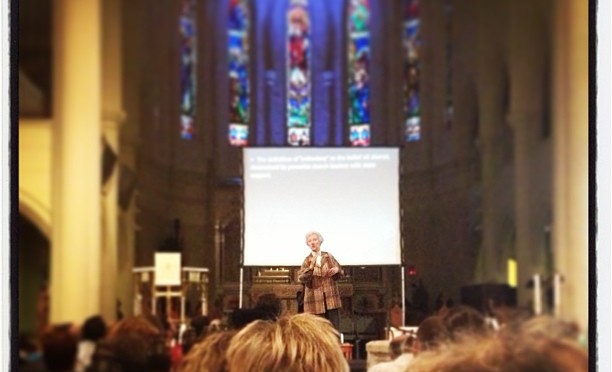
Second, the confusion began when several people in the room tweeted objections which were put up on the screen behind Phyllis as she spoke. This brings new meaning to “talking behind someone’s back.” It felt incredibly rude and helped set a very confusing tone.

What I heard.

Phyllis’ final presentation spoke to the nuclear family and the change brought the 20th Century. In her landmark book, The Great Emergence, she references the nuclear family as the result of the Great Reformation and Protestantism. She raises this as evidence of the new thing that was Protestantism and as evidence of how different Emergence is. To say that Phyllis was advocating going back would be equal to her suggesting we reject Emergence for Protestantism. Which she doesn’t.

This further colors the way she concluded her talk. She told a personal story of transmitting the Christian story in a way that demonstrated fidelity to the core value of Emergence: what we used to call authenticity. Her current work on the revelation of the Spirit and the ways Emergence Christianity seeks to make community meaningful and consistent and of value all but required her to speak to a meaningful, personal, and local practice of storytelling.

There is no doubt that her comments about women’s roles in family and church were bound to stir people up. I also recognize that she didn’t articulate her vision clearly. However, to hear her comments about the Pill and “menses” as negative is to ignore all that Phyllis has written and spoken to previously, including the previous 24 hours! And further mistakes an important aspect of her thesis: the death blow to Sola Scriptura is the sex stuff: particularly the rise of women in leadership and the place of LGBT in Christian community. She argues that the biggest game changer in the 20th Century is the Pill. She didn’t denigrate the Pill (though she did make a couple of bad jokes), but raise it up as the lighting rod for the 20th Century’s culture war.

When people blame something for something else (the Pill for our current state of affairs), they are doing two things.

  1. Scapegoating something
  2. Calling something else bad

We see this all the time. For example, the decline of “traditional” marriage has to do with those gays wanting to get married is the popular argument. Implicit in that argument is that something (LGBTs wanting to get married) is the reason something else is bad (that “traditional” marriage has declined) due directly to the interaction of the two “somethings”. The same argument is made about the Pill, premarital sex, sex education in school, and any number of other things.

The problem with suggesting that Phyllis blames the Pill for the current state of affairs is found in that connection, particularly as it applies to number 2. She doesn’t think that the way things are is bad. She doesn’t speak negatively of the “decline” of church or the need to bring the “glory days” back. In fact, she is incredibly positive and hopeful about the way things are.

This is why I say that I heard what was offensive and understand where it is coming from, but an essential part of the argument is missing: that the Pill is to be blamed for something, since she didn’t appear to be arguing that something else was bad. As always, she chronicled the events of the 20th Century and highlighted what changed our course and then ended with an Emergence (not Protestant) example of transmission of identity. One that appropriately challenged me to be more honest and Spirit-filled in all of my life, including who I am with my family. It was a weird way to end the conference, but it certainly got us thinking and talking. I’ve got to say, I like that about it.

If you were there, what did you think about the conference?

A Ridiculously Basic Introduction to Emergence Christianity

Before I begin, I need to give a whole bunch of caveats. First, this is not only ridiculously basic, but inappropriately basic. The subject is too big to cast in just a few sentences. Second, you should probably just go out and buy Phyllis Tickle’s book of the same name and read it yourself. Third, I have not actually finished the book, but will do so this week. This introduction is to the subject and based on a set of lectures and the conference from this past weekend. Fourth, I am writing this post with my congregation in mind, rather than my regular readership. You are warned!

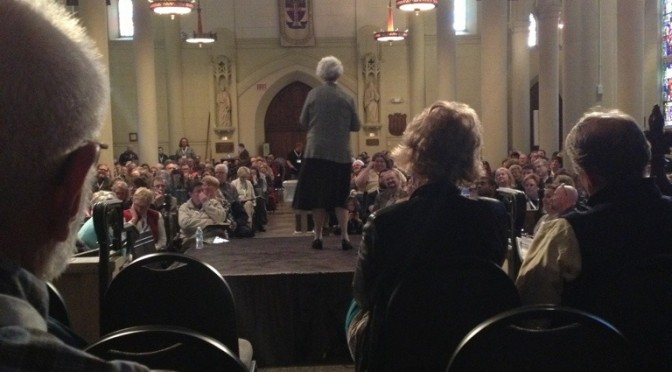
Phyllis Tickle speaking at Emergence Christianity 2013 in Memphis, Tennessee

Phyllis Tickle speaking at Emergence Christianity 2013 in Memphis, Tennessee

We are currently living in an age of Christianity that many have begin calling an age of emergence. Here are my primary words on the subject and then some of my writings about emergence.

  • Every 500 years or so, the world (not just the Christian world) goes through a great upheaval. The last one was the Great Reformation that coincided with the Enlightenment. We are in another, called the Great Emergence.
  • The era seems to have begun on September 11, 2001.
  • In each upheaval, half of our time is spent figuring out what is going on and the other half is spent living into it. We are in the heated former moment, in which we are rejecting what no longer works and discovering what will.
  • In each upheaval, there is a grand restructuring of all of Christianity, that takes about a century. This is our phase. Last time, Protestantism was born. This time, Emergence is being born.
  • Like Protestantism, Emergence isn’t itself a denomination, but a collection of unaffiliated expressions of a common/similar faith. Therefore, there are many different ways of expressing Emergence. From the emerging church to neo-monasticism to the artist collectives like Ikon, Emergence Christianity is being expressed in a variety of places, including existing churches, such as the Episcopal Church.
  • Emergence Christianity is a new strain of religious expression, and therefore is not just a means of appealing to young people or an excuse to play contemporary music, though these might be reasonable parts of that expression. Emergence brings with it different sets of expectations and ideas about scripture, theology, tradition, worship, etc. that are entirely compatible with the existing institutions. However, the existing church has operated with different priorities.
  • North American Christians are the last ones to this party. The rest of the world has been dealing with Emergence for much longer.
  • And way more than this.

As I wrote on Friday night during the conference, something has changed. We used to call this stuff “emerging church”, which caused people to think of it as a particular church or way of doing church. Then we began to describe this as the “emerging conversation” because it was more about the dialogue and figuring out of what was happening. Now, we are beginning to speak of the subject as “Emergence Christianity” because the focus has shifted a bit from practice and dialogue and toward the understanding of the Emergence as a movement.

The direct impact on our churches locally is as significant as we want it to be. But we are increasingly being forced to deal with a way of being Christian that increasingly matches the sensibilities of the people and existing ways that are increasingly mismatching with people; even people that have spent the last 60+ years in our church.

Feeling the Movement

20130111-235502.jpg

Here in Memphis, I’ve joined together with many Christians to celebrate Phyllis Tickle at the Emergence Christianity conference (hash tag #EC13). We’re hearing presentations from Mrs. Tickle about the subject of the book of the same name (Emergence Christianity) and responses from dozens of people involved in emergence. I’m loving it!

There is plenty to say, and I may do so after I get home. But what I am really getting the sense of, more than ever before, is that this thing she is describing is not just a thing and not just a moment, but a movement. A group of people conversant in emergence got together yesterday to discuss whether or not those participating in the emergence conversation are in fact part of a movement and apparently they agreed. Today, listening to Phyllis talk about where we’ve been as church and where we are going, it really felt like I was part of a movement. Not that I got in on the ground floor, mind you. The people who got together at the first Emergent Gathering can make that claim. But it did feel as if something is starting now and that something is ours in this moment and that we are part of something big that is moving beneath our feet.

I hope to explain it more, but for now, I’ll end with this: I love church. Not necessarily my church, because that makes an idol of the local. And not necessarily The Episcopal Church, because that makes an idol of the tribe. But I love feeling that the church has a future and more importantly, that we in the church will be doing big things.

20130112-001745.jpg

For All the Saints

We often refer to two different strains of Christian faith: Catholic and Protestant. These two traditions have very different understandings of saints. To Catholicism (such as Roman Catholics), saints are our intermediaries. They have been elevated by humanity for their godly and miraculous works. Protestantism (such as Presbyterians, Lutherans Baptists, etc.) has downplayed the role of saints in the church and in private devotion. To many, praying to saints is too “Roman”. Personally, I’m fond of the Reformation Era word “papish” but I digress!

Episcopalians believe both. Or, better, neither. We are part of a third tradition that is another strain of Christianity, known as Anglicanism. There are two other traditions (Orthodox and Pentecostalism) which have a similar “other” status in global Christianity. Phyllis Tickle postulates that a 6th strain is forming, currently called Emergence.

As Anglicans and Episcopalians, we have saints. But we don’t ordinarily pray that they intercede for us. We feel as if we can pray directly to GOD, thank you very much. However, saints aren’t nobodies. They are guides, leaders, and role models. They show us how to live a godly life.

In recent years, The Episcopal Church has expanded our list of saints greatly. Our list, now called Holy Women, Holy Men, is a broad and diverse collection of people.that have gone before, which includes many women, minorities, and figures from under-served countries and provinces. Our list represents the diversity found in our faith and is now much closer to embodying the beauty of Anglicanism than ever.

We often make All Saints’ Day about our personal saints–those people we’ve known personally that live a godly life no longer. Perhaps this year we take time to get to know all the saints. Then in January, we will celebrate the feast of our patron saint, Paul.

Saints aren’t remembered for their having died. For their friendliness. For their being a good coworker or friend. What makes a saint is that by looking at them, you can see GOD.

This week, let us remember all of those saints we have known and will know.

Belief v. Action

In church circles there is a lot of exercise around the idea that there is dichotomous relationship between our beliefs and our actions. This is particularly evident between the groups Phyllis Tickle refers to as the Social Justice Christians (ie. the Mainliners) and the Conservative Christians (conservative evangelicals and Southern Baptists). In this paradigm, one group is overly focused on what we do to bring about the Kingdom of God and the other is overly focused on believing the right things so that we can get to heaven. It is a self-conscious tug-of-war between Christians who see almost nothing in common between their belief systems. Of course, this is all fabricated ridiculousness to divide us.

One of my favorite analogies is whenever people talk about men and women being totally different I trot out the one biological fact I know: chimpanzees and bonobo apes have 99% identical DNA to humans. So if we are 99% the same chimps and bonobos, then how out of proportion are we blowing up that 1%? Clearly the same case could be made for Christians, but that isn’t my purpose precisely. It is this: the dichotomy is false and intentionally so.

I came across this picture on Facebook yesterday that I found compelling. Personally compelling. It was also compelling in light of that false understanding of human belief and behavior.

substitute "Christian" for "person"

Jesus’s method was to encourage action that demonstrates active belief. He really did seem to make the proverbial case of being what we eat. Our actions are an outpouring of our internal thinking. This is why He was so concerned with not only the lust we express, but the lust we don’t. The lust in our hearts is as corrupting as anything. But this isn’t solved by restricting behavior or simply adopting the right creed. The lust in our hearts and the lust we express aren’t changed by adopting our church’s statement of belief and just thinking harder. Human psychology doesn’t work that way. That is why it is statistically true that dieters gain weight rather than lose it. We cannot will ourselves to be different simply by adopting either a new external belief system or changing our expected behavior. It comes from having internal and external transformation. We have to get that better eating is good for us, not simply understand it.

In directing us to see sin as not simply outward action, but internal struggles that are beyond our intellectual debates, but operate in our base, human urges, we can come to see that there is no difference or separation between our beliefs and our actions. They are, in fact, the same. They are also inseparable. And ironically, both Social Justice and Conservative Christians make that very case.

The difference between how we perceive these two (belief and action), however, and how they function is significant. Just as they are inseparable, they are also (together) demonstrable, in both positive and negative action. We demonstrate our belief at the soup kitchen and when we cut funding for food stamps and Head Start. We demonstrate our belief when we discourage rape in Africa and when we encourage the killing of LGBT in those same countries. Our belief is on display when we advocate for The Other and when we sit on our hands.

The sole difference between the two is a belief that our actions should be prioritized in any way other than Spirit-filled Kingdom building. Giving preference to evangelism over justice, or vice versa. Giving preference to worship over politics. Giving preference to internal community-building and preservation at the expense of the outside world. We can intellectualize our faith to be solely about our own stuff and our own prejudice. We can compartmentalize it to be something that exists only in our heads or only in our hands. We can pretend that Christianity can be boiled down to a simple theological statement, or worse, a single verse, or worst, the verse’s very name: John 3:16. As if making a public declaration of that, and only that, is what constitutes belief and action.

What matters, in the end, is who we are. And that word “are” is a verb. It isn’t the most active verb there ever was, but there you go. Who we are. We aren’t our beliefs. We are who we are to the world. It isn’t an intellectual exercise, but an engaging, Spirit-led experience of our community and our struggles. Who we are is what we do with others and what drove us there.

Trying to split the hairs at the 1% difference masks the reality that our beliefs and actions are misaligned. And we like it that way. That’s how we recruit people to our camp. How destructive are we?

The New Authority: Trust

Deutsch: Polizeihauptmeister MZ (mit Zulage) a...

Phyllis Tickle, in The Great Emergence, outlines our past, describes our present, and previews our immediate, swirling future into what she calls the Great Emergence.  The book is now over three years old, but as astute as ever.  In it, she tackles the question of authority as I raised in a previous post about the Anglican Communion.  I wrote that the source of our biggest conflicts are around the nature of authority and that, as Tickle suggests, we battle every 500 years or so over the who/where/what/why/how of authority.  Specifically, how do we resolve issues in which  there is no discernible structure or force that has jurisdictional punishment over bad actors?  Or, how do we deal with conflict without either a person or a system that has authority to punish?  My response is simple: our punishment simply matches our source of authority.  We just have trouble seeing it yet.

The specifics of conflict are actually pretty common: the kid that gets away with bullying because he does it online or because she isn’t physically seen by a teacher; the youth that gets away with stealing from his neighbors because his Dad is a police officer; all the way up to the president who simply ignores the law on torture or war powers.  Each is a case of someone who gets away with a crime because there is seemingly no mechanism for curtailing the behavior.

Well, Tickle outlines the last two battles each yielding a new sense of authority that made sense for the age.  With the Great Schism in the 11th Century, the answer of who has authority was to put it in the hands (or the seat) of a single person: the pope.  Therefore one person can be the final judge on all things Christian.  Which was great, until there were more than one person claiming to be the pope.  And the pope didn’t seem to have all of the answers.  Or he had the answers, they were just inconsistent.  So in the 16th Century, through the Great Reformation, authority shifted from a human to a book.  Sola Scriptura! they shouted!  And suddenly all authority rested in an inanimate object.  All of the answers could be found there…until they couldn’t.  Until there were too many ways of reading a “plain reading” of the text.  The great revolution that put the Bible in the hands of individuals, led to the downfall of Scriptural authority, because individuals came to different conclusions without the structure of the church.  The Great Reformation worked almost too well!

How Tickle describes the current age, the beginning of the Great Emergence, is to argue that authority will be found not in a person or in a book, but in the network.  That the collection of people, not as a structure, but as a loosely affiliated network, would come to agreement more organically.  I loved the idea when I read it three years ago, but I haven’t been able to quite see it until now.

The problem is that we are dependent on those other means of authority, institutional structures, individual decision-makers, irrefutable texts, and we lazily understand our own part as imbibing what the smart people say and following along.  But the new sense of authority rests in how we come together and upon that which we can agree.  This is to say, not in ignorant cultural beliefs necessarily, but in active attempts to wrestle with questions and problems.

What this means for my specific question is that these individuals get away with criminal behavior because we collectively allow them to.  We don’t stand up to it, either as individuals or as a group.  We allow others to deal with it (or not).  This isn’t a call for vigilantism, far from it, but collective action. It is us who ignore the bully, relying on teachers and principals to act, rather than step in as a class.  It is us who allow a youth to be protected by his place in society.  It is us who allow a president to carry out heinous acts in our name or perhaps more disgustingly, in the name of freedom.  Our action opportunities are plentiful.

Emergence

Image by hybrid756 via Flickr

It comes down to trust.  Our current behavior demonstrates that we don’t trust the system, we simply rely on it and expect it to function.  Then when it doesn’t, we condemn it.  Sometimes we even argue that the system can’t do it.  And even then we still don’t hold the community responsible for cleaning up the mess.

Perhaps this is why there is so much confusion about the Occupy movement, as it is not about political expediency but method and consensus-building.  The way it functions isn’t just a political tactic, but a vision of new community.  Community without a singular figure-head and decision-maker.  No Scripture to hold up as an idol.  No specific confession to demand adherence to.  No institutional hierarchy that demands allegiance.  It is people standing up and taking care of each other.

And that is also a vision of trust.

Wishing It Doesn’t Make It So

English: Flag of the Anglican Communion, with ...

Whether or not you follow the politics of the Anglican Communion is probably related to whether or not you have a mental illness.  Nevertheless, my people have been engaged in a struggle that represents the very understanding of authority in the postmodern age.  Which is actually pretty cool, in that geeky sort-of-way.

Here’s my basic overview:

Since the 1960s or maybe even earlier, certain groups began planning to leave the Episcopal Church.  Some leave sporadically over the ensuing years, primarily over difference in theology and authority.  Then, in 2003, it all starts to happen.  Several bishops, dioceses, congregations, clergy, and individuals start making a claim of independence from the Episcopal Church taking several forms, eventually coallescing around two primary entities: ACNA (Anglican Church in North America) and AMiA (Anglican Mission in the Americas).  These two groups are sanctioned by overseas bishops.  The Episcopal Church and our northern neighbors, the Anglican Church of Canada, the dissident groups, and the overseas bishops are all scolded for their behavior.  Then, under continued pressure to further sanction the Episcopal Church, a scheme to write an Anglican Covenant is devised, which is playing out right now.

In actual practice, the only ones that have broken canon law of the Anglican Consultative Council (ACC) are these overseas bishops, who have attempted to set up parallel jurisdiction in North America, which is a real no-no.  It is also of no small consequence that these same entities (with help from schismatic Anglicans over here) claim justification for their law-breaking based on a supposed breaking of faith and community on the part of the Episcopal Church (TEC) and Anglican Church of Canada (ACoC).

This issue brings up a whole host of questions, but there are a few specific ones I am interested in.  And before I go any further, I am not interested in flame-throwing or discussion of heresy or liberal tyrrany or other such inequitable and offensive non-conversation.  Here they are:

  1. Do we really hold as equal the conjecture of assumed unspoken laws and the actual breaking of real ones?
  2. Shall our U.S. love for revolution balance with our love of imposed equilibrium?
  3. Shall a spirit of mercy and forgiveness influence our future? Or shall pure legalism?  Or shall brute force?

There is a wonderful conversation going on over at Mark Harris’ blog, Preludium, about a hypothetical arrangement in which a parallel system might happen.  What is most profound is Harris’ response that there is one really good reason that it won’t:

Because no Communion of Churches in its right mind will deliberately include a new member church that exist precisely because the new member Church believes an existing member church to be un-Christian, heretical and not truly Anglican. Because the Anglican Communion has some interest in being in its right mind, that is a communion in which scripture, reason and tradition all play a part in discernment, the Anglican Communion will avoid, if at all possible, doing something as blatantly stupid as inviting membership from a church already a break-away from a member body.

He gives a second reason, based on the legal foundation, but this one superbly declares the problem of being the one who breaks something, then seeking to be seen as equals, with that same maturity and authority.  This, of course, is the nature of spin.

All of this is related to a gigantic cultural question that has been baring down on us for most of the 20th Century.  It reared its ugly head in the 2000s and won’t leave us alone until we deal with it.  It is so massive, that we, like the proverbial elephant, find ourselves arguing over defining it, while only seeing its parts.  That question is about authority and where it comes from.

Phyllis Tickle, in her prescient book, The Great Emergence, describes our history and all of the big questions of our history as relating to this simple question of authority.  Who has it?  What constitutes it?  How do we agree upon it?

What has been breaking through has been our inadequacy in dealing with the consequences of challenging authority.  Specifically, what happens when people or countries break certain laws?  Whether that is the U.S. military under Bush defying the Geneva Conventions through torture and indefinite detention or churches breaking canon laws, we are seeing few adverse ramifications for breaking many actual laws and treaties.  There seems to be no penal or social punishment for these sorts of actions.  This, of course, is aided by the “self-defense” scapegoat.

So, how do we deal with actual law-breaking when we have no prescribed means of punishment?

My response is coming tomorrow.  What do you think?

Just Cut the Church Programs

For several weeks I’ve been writing about engaging different groups in church.  Then I wrote about dealing with time constraints and what it means for planning.  Now, I am making a personal appeal for an entirely different approach: it is time to get rid of our programs.

As Phyllis Tickle adeptly outlines in The Great Emergence, the post-war world of the 1950s led to a curious new development in church life that has remained intact ever since: churches full of programs.  The roots of this development are quite simple at the macro-level, but remain entirely unexamined at the micro-level:

  • In the late 1940s, as soldiers came home, new communities were created to mimic
    Sunday school class, Manzanar Relocation Cente...

    Image via Wikipedia

    the ones soldiers and their spouses lived in before the war.  Suburbs grew and many churches were founded in the center of these communities.  Parishes built big parish halls and community centers to serve the wider community.

  • Women, who only years earlier, had left the home to go to work full-time, were itchy to get out again and began extensive volunteering at church, providing leadership for much of the church programming.
  • As that generation aged, Boomer women went to work and most Boomers left the church entirely, leaving all of those programs behind.
  • Their parents, now seniors, became the first generation able to retire with time left on the clock, so many seniors pick up the volunteering slack.
  • With each decade, the influence of seniors grows as they are able to retire earlier and live longer.
  • We have essentially maintained this same arrangement of senior volunteerism since the late 1960s.  Boomers, and the succeeding generations (including Gen X, Millennials, and the next generation) have much less church experience than their parents and grandparents had, making senior seniority even greater.

What we are left with in 2011 is an overall decline in Christian attendance, participation, and capacity to join meaningful Christian communities across all denominational groups: some hit more than others.  Rising costs make institutional church archaic, as a huge percentage of the annual budget is tied up in buildings and staffing.  These areas have costs growing much faster than giving, making the current arrangement in most churches unsustainable.  As the fiscal costs to maintain the system go up, so do the social costs.  Maintaining existing levels of social engagement in the church programming is taxing the aging volunteer base and causing real stress on the social makeup of our congregations.

Given the above challenges there is only one clear solution.  Ditch the programs.

I’m not saying that we stop delivering food baskets or offering opportunities for the church to act like the church.  But many of our churches are living into a church model that is inappropriate for their size and makeup.  The average church has an Average Sunday Attendance (ASA) of about 70. This means that the vast majority are a “pastoral-sized church”.  They would have to more than double their regular attendance to begin moving into a new model, triple it to make the transition.  The next model is appropriately named “program”.

Most churches should simply stop using the word “program” at all.  It comes from a different model of church.  It isn’t yours.  Just stop calling things programs.  They should also stop seeing the arrangement as “programs” being what we “offer” to our community.  Instead we should embrace what we as the community value together.  This simple shift in focus more accurately embodies the dynamic most churches are rather than what they were or believe they are supposed to be.

St. Swithin’s in the Swamp with 75 on a Sunday “offers” Christian Education in the form of Sunday School to differing age groups, with 2-3 children per class during their 10:30 am worship service.  They then have their different fellowship programs during the week, which are sparsely attended, and occasional Outreach events in which the same dedicated volunteers come out and work for two straight days, making a herculean, but rewarding effort.  All of this is commendable and wonderful.  However, it causes incredible strain on the community.  The people don’t know what else to do.

This really is quite simple.  Stop.  Just stop.  Then figure out what you’re good at, what you value, and how you are called to live.  It doesn’t matter how much you “offer” since it will never be quite enough and isn’t the panacea we’ve all taken it for.  Christians aren’t only doers and believers: we’re be-ers.

The mythical St. Swithin’s is better off sharing in spontaneous intergenerational formation and worship together, and engaging Bible Study, faith formation, and preparation in natural groups.  The mission of St. Swithin’s is lived out in corporate participation in direct community needs as one, tackling needs evident in their neighborhood or brought to the congregation by individuals within it.

This isn’t just a difference in words, but a fundamental difference that can only happen by living out a different way in all aspects of congregational life.  Otherwise, the pursuit of programs will kill our congregations.