See the degree of inequality

For many of us, the notion of inequality is intolerable. A system that perpetuates poverty is an affront to our faith and belief about what we are called to do in this world. Of course not everybody has the same conviction.

As this video highlights, however, virtually everybody believes the system is inappropriately rigged and should be different. What is striking is how different the actual world is from what we think it is.

This is suffering. This is self-induced, systemic poverty. And it has to change.

More Christian Than Christians

A year ago when the Occupy Wall Street movement developed, it was easy to recognize a correlation between the church’s mission and #OWS’s. It’s participants were attempting to forge a different way of gathering that was egalitarian and grass roots. It’s decision making was communal and encouraged a type of shared leadership most churches can only dream of. And it represented a sense of radical equality and justice that is consistent with the gospel.

It was also easy to snipe at. Conservatives and Liberals both attacked the movement for not looking like more traditional movements or turning into a think tank that writes up public policy and lobbies for their adoption. By trying to live in a different way with different priorities and a different understanding of success, the beltway establishment, desperate to evaluate and judge the movement, criticized it for what it wasn’t. Perhaps because it didn’t understand what it is. It still doesn’t.

I’ve always thought there was much that it could teach those of us in church leadership (and here are other posts about #Occupy). Now I’m just overwhelmed. With Strike Debt and its new project, Rolling Jubilee, they’re doing what we’re supposed to be doing. As in specifically the very thing we ought to be doing: bringing justice, saving people, and destroying predators.

Rolling Jubilee – an ancient principle updated for the 21st Century

When I saw the announcement of the Rolling Jubilee a few weeks ago, I recognized something that would be troubling for many in the religiously-affiliated Judeo-Christian set: a secular organization organizing around our idea of jubilee. It raises those old arguments about whether something can be Christian or Jewish without it being about GOD, and new ones about the “spiritual but not religious” set. I do have some of those reactions.

I’d love to hear yours!

Here’s the thing, though. This question is honestly very important. It is made all the harder for us because we aren’t doing anything like this. Furthermore, it is good Christians who actually create this system of oppression, breaking the commands to charge no interest and to not exploit the weak. We aren’t bringing the Kingdom closer when we believe in personal ownership and ignore the cries of those in pain: two radically unChristian behaviors.

Is it possible that GOD is doing a new thing with new people because we aren’t getting the job done? Isn’t this what emergence looks like?

There is More Than Supply and Demand

Robert Reich

Robert Reich (Photo credit: victoriabernal)

One of my pet peeves is false dichotamies. You know, when we make complex problems into simple either/or solutions. Like politics. That’s why Robert Reich’s recent column struck me this morning as I read it. He was talking about what the U.S. could learn from the European economic crisis, which is a telling case of what not to do. But he wrote these significant words:

In truth, the choice isn’t simply between budget-cutting austerity, on the one hand, and growth and jobs on the other.

It’s really a question of timing. And it’s the same issue on this side of the pond. If government slices spending too early, when unemployment is high and growth is slowing, it makes the debt situation far worse.

What supply-siders like to suggest is it really is entirely about the dichotomy. That the economics boils down to the simple equation of supply vs. demand. The same goes for an economic crisis: you either cut or increase spending, as if these are the only metrics. In this case, cutting almost always sounds better than increasing, so their side sounds good. But as Reich points out, one unaccounted for variable is timing. As in when things happen.

If we pretend timing has nothing to do with it or perhaps the actual pain caused by austerity measures on actual people has nothing to do with it, we can make seemingly easy decisions. Many times in my own life have I or my wife had to look at the timing of our bills and the timing of our paydays, so don’t dare tell me timing doesn’t matter.

Or if any student of economics argued in class that cutting is cutting without regard to the economic conditions, s/he would be laughed out of the program. So why should we make our arguments so devoid of context?

Question:
What other areas might we benefit from breaking open a dichotomous stalemate?


The New Authority: Trust

Deutsch: Polizeihauptmeister MZ (mit Zulage) a...

Phyllis Tickle, in The Great Emergence, outlines our past, describes our present, and previews our immediate, swirling future into what she calls the Great Emergence.  The book is now over three years old, but as astute as ever.  In it, she tackles the question of authority as I raised in a previous post about the Anglican Communion.  I wrote that the source of our biggest conflicts are around the nature of authority and that, as Tickle suggests, we battle every 500 years or so over the who/where/what/why/how of authority.  Specifically, how do we resolve issues in which  there is no discernible structure or force that has jurisdictional punishment over bad actors?  Or, how do we deal with conflict without either a person or a system that has authority to punish?  My response is simple: our punishment simply matches our source of authority.  We just have trouble seeing it yet.

The specifics of conflict are actually pretty common: the kid that gets away with bullying because he does it online or because she isn’t physically seen by a teacher; the youth that gets away with stealing from his neighbors because his Dad is a police officer; all the way up to the president who simply ignores the law on torture or war powers.  Each is a case of someone who gets away with a crime because there is seemingly no mechanism for curtailing the behavior.

Well, Tickle outlines the last two battles each yielding a new sense of authority that made sense for the age.  With the Great Schism in the 11th Century, the answer of who has authority was to put it in the hands (or the seat) of a single person: the pope.  Therefore one person can be the final judge on all things Christian.  Which was great, until there were more than one person claiming to be the pope.  And the pope didn’t seem to have all of the answers.  Or he had the answers, they were just inconsistent.  So in the 16th Century, through the Great Reformation, authority shifted from a human to a book.  Sola Scriptura! they shouted!  And suddenly all authority rested in an inanimate object.  All of the answers could be found there…until they couldn’t.  Until there were too many ways of reading a “plain reading” of the text.  The great revolution that put the Bible in the hands of individuals, led to the downfall of Scriptural authority, because individuals came to different conclusions without the structure of the church.  The Great Reformation worked almost too well!

How Tickle describes the current age, the beginning of the Great Emergence, is to argue that authority will be found not in a person or in a book, but in the network.  That the collection of people, not as a structure, but as a loosely affiliated network, would come to agreement more organically.  I loved the idea when I read it three years ago, but I haven’t been able to quite see it until now.

The problem is that we are dependent on those other means of authority, institutional structures, individual decision-makers, irrefutable texts, and we lazily understand our own part as imbibing what the smart people say and following along.  But the new sense of authority rests in how we come together and upon that which we can agree.  This is to say, not in ignorant cultural beliefs necessarily, but in active attempts to wrestle with questions and problems.

What this means for my specific question is that these individuals get away with criminal behavior because we collectively allow them to.  We don’t stand up to it, either as individuals or as a group.  We allow others to deal with it (or not).  This isn’t a call for vigilantism, far from it, but collective action. It is us who ignore the bully, relying on teachers and principals to act, rather than step in as a class.  It is us who allow a youth to be protected by his place in society.  It is us who allow a president to carry out heinous acts in our name or perhaps more disgustingly, in the name of freedom.  Our action opportunities are plentiful.

Emergence

Image by hybrid756 via Flickr

It comes down to trust.  Our current behavior demonstrates that we don’t trust the system, we simply rely on it and expect it to function.  Then when it doesn’t, we condemn it.  Sometimes we even argue that the system can’t do it.  And even then we still don’t hold the community responsible for cleaning up the mess.

Perhaps this is why there is so much confusion about the Occupy movement, as it is not about political expediency but method and consensus-building.  The way it functions isn’t just a political tactic, but a vision of new community.  Community without a singular figure-head and decision-maker.  No Scripture to hold up as an idol.  No specific confession to demand adherence to.  No institutional hierarchy that demands allegiance.  It is people standing up and taking care of each other.

And that is also a vision of trust.

(Dis)order and Witness

Since the Occupy protests began, I’ve been struggling with what is so objectionable to so many people about protest.  Perhaps I am as pinko as my former rector, Matt+ says I am, but I’ve never found protest in itself to be ugly.  Between my own limited experience and the research I’ve done, criticisms of protests of most sorts are entirely wrong.  Wrong in tone, if not substance.

In this age, we remember fondly the Civil Rights Movement and its champions; exalting the pain they endured while, even now, some thugs continue to spit in their faces.  The associations with violent protests are told as bogeymen, haunting safe, suburban America.  A dozen protestors threw rocks!  It was chaos!  The American way of life was under siege!  We had to respond with tear gas, rubber bullets, tazers, and batons!  We had no choice!

Even our 21st Century protests have been incredibly orderly and peaceful, turning ugly only after riot police get involved.

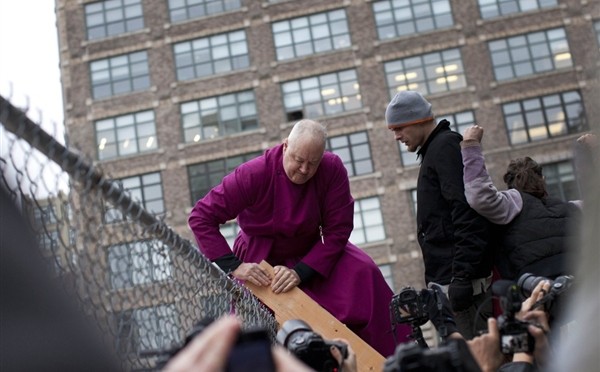
As I wrote the other day, I was moved, not by the thought of Bishop George Packard getting involved in Occupy Wall Street, or the image of his going over the fence or his being arrested.  I was moved by the image from Twitter of him in handcuffs surrounded by these really normal people.  On his face is an expression of listening and of knowing.  It really was the image of Christ in our midst, struggling to help us break free from the bonds of our culture.  This bishop, the quintessential image of churchly order was sitting in our image of civil disorder.   The profundity of Christ in our midst, in Advent, left me utterly speechless.

There is something really telling about the American condition, particularly the pernicious Protestant work ethic, so constant and domineering, that demands greater efficiency and respect for a person’s work (but not necessarily their character, gender, DNA, or existence).  We are perpetually worried about the impact of civil action on our personal lives in the form of inconveniences, but rarely give a thought to those that are real grievances.  When a person blocks the sidewalk, we are thrown in a tizzy at them for the small inconvenience they have made for us, but the condition that places them there: be it poverty, desperation, hope, or perhaps providence: well, that can’t possibly be our business.

The federal and state governments’ use of protest zones and most city government’s use of armed force to remove people from public property are signs, not of any liberty, but of a preference for order.  The clockwork movements of people getting to work and meetings is orchestrated to maximize our profit potential.  None of this allows for spontanaity or holy intervention.  There is no opportunity in these highly efficient pathways to power to allow for Christ to be among us, to surprise us unawares.  We would, no doubt, have our heads down, anyway, unable to see His face, even when three feet from our own.

The real tension the Occupy protests have revealed, and it is fitting that many have moved to housing occupation; giving voice to the issue of bank foreclosures.  This is particularly revealing, not simply the banking practices and our own indifference to the financial health of our neighbors, but to the very concept of people being removed from their homes.  The very image of people being relegated to the street.  And once there, the city can round them up and deport them from downtown, sweeping these Christs away like the dust we all are.

[Featured Photo: Bp. Packard (Andrew Burton - Reuters)]

Link

Elizabeth Kaeton preached the quintessential Advent 4 sermon–about Occupy Wall Street.  Amazing!

This has me moved to see a simple idea.  Head on over, read it, and then reflect over that picture of Bishop Packard for a moment.  When you are done, come back and ask yourself the following question:

What if, in the midst of all of our structures and beliefs and plans, G-d is here, breaking through?  What if this is the image of G-d and anything but support for it is a denial of the kingdom?

The excuse of fear: “nonlethal” force and the powerful

In the week between when the world discovered Sgt. Shamar Thomas, some dudes went crazy.

The viral video of an Iraqi veteran chastising the New York police department for arming up against their own civilians as if it were a war zone was a wake-up call to the sleeping public.  These public protesters aren’t impudent and dangerous people.  The #Occupy movement is no mob.  Since the massacre at Kent State, we’ve watched the tug-of-war between protests in the U.S., which by world standards are about as dangerous as mimes pillow-fighting, and police sent out to defend the public.  When protests have gotten ugly what is revealed is the fear on the part of city officials to handle disruption.  The wrench in the machine is the most frightening thing.  They argue that it is about public safety, when it is about eliminating disruptions.  Gotta keep the trains running on time!

Sgt. Thomas preaches understanding to cops who have just man-handled protesters and, as you can see in the background, new cops come out wearing riot gear, and were moving in again.  But these words of his are the most chilling:

“They don’t have guns!”

Stop and think about this.  Get rid of your own visions and the idea of big crowds of people and just remember this one thing: these people aren’t packing.  Nor are they planning an assault on an enemy compound.  They are just people.

He asks why the police insist on beating up the unarmed citizens of his neighborhood and declares

“There’s no honor in this!”

If you haven’t seen it, watch it now.

This became a further stunningly gruesome reality in our country on Wednesday morning in Oakland. The indelible vision of unarmed protesters, attacked with rubber bullets and chemical weapons.  After cops had driven people out of the park, they tried to go back in, only to be further bombarded by tear gas and flash bombs.  The scene escalated to this widely circulated video.

I don’t envy the cops, or even the police force itself.  A few bad actors have abused their power in these protests, but it is these mayors and chiefs of police that have planned these engagements.  They have employed “nonlethal” force as some excuse that seems to say “well, we didn’t actually kill anybody” when the anybodies in question are unarmed civilians.  We only physically abused them, cracked a skull, pepper-sprayed them, and harassed them incessantly!

We cannot escape the power differential: that one group is prepared for war and the other is calling for peace and equality.  The irony should be lost on no one.

I don’t care where you are politically, but the sight of the brutality in Oakland is gruesome.  There is no honor in this.  There is no defense for this.  This is where the powerful, but morally weak run to when they are afraid.  Violence upon the powerless and morally just.

If we ask but one question: Of what are they afraid?  These people have no weapons.  They are sleeping in tents and marching to banks to close their accounts.  They are singing and protesting.  Of what are they really afraid?

© 2011 Drew Downs.  All rights reserved

The Gilded Age of Media

When faced with something they find confusing, most journalists give up.  They don’t do the real legwork of engaging the story.  They write the “process story” instead.  You’ve read the kind in which the author doesn’t actually write the story about the intended subject’s work, but how confusing that work is.  They trot out tired tropes about nails and Jello and hammering something when they should be spending a few minutes actually engaging the material.  I’m just saying.

So we’ve now spent the last four weeks hearing from the news media that Occupy Wall Street has this messaging problem and “nobody” can explain what they want.  [Hello!  They actually wrote a document forever ago!] Blah blah.  Some stuff about how they have no goals or direction.  Blah blah.  Then something about what Republican congresspersons say about them.  Blah blah.  Then some personal anecdote revealing the journalist’s secret disdain for anything outside the norm of beltway horserace-jargoned politics.  Totally lazy and inappropriate.

Here’s the problem:

In late 2009, when people started a movement chanting the famous Reagan quote: “Government is not the solution to our problems, government is the problem” while complaining about having that said government collect any taxes at all, but were also (apparently) satisfied with the current tax rates (taxed enough already?), the media fawned all over them and now talk about the consistency of their message.

In late 2011, when people started a movement changing the famous Reagan quote to say: “Wall Street is not the solution to our problems, Wall Street is the problem” while complaining about said Wall Street’s collective dramatic windfall over the last 30 years at the expense of, well, virtually the entire country, suggesting we raise taxes on the top 1% and alter the lax regulated environment, the media got flummoxed and stared at each other totally confused and dumfounded.  What are they talking about?  It sounds like complete gibberish!

Credit: AP Photo/Atlanta Journal-Constitution, Curtis Compton

If you don’t have eyes to see the common themes in the above signs, then you can’t see.

Clearly the media has swallowed the blue pill and decided that a message that is anti-government and inconsistent about taxes is clear and concise, while a message that is anti-Wall Street excess and social contract devastation is some massive word jumble.  Clearly, the Tea Party, which began with the fervor of some ideological firebrands that are strongly libertarian was long ago co-opted into long-term conservative think tank arguments.  That the Tea Party is at once referencing both grassroots libertarians and die- hard social conservatives who have been in Washington for two decades should be more confusing to pundits.  And yet that message is taken for granted: it is not only domesticated, it is normal.  Average.  The way of conservative politics these days.

At the same time, the media is loath to examine the very substance of this rhetoric, instead, they would rather spend their time writing the horserace story about which Republican is up in the polls.  If they are forced to cover the #Occupy movement, they’ll just phone in a process story.  I mean, really, who wants to deal with the actual substance of income inequality and corporate greed.  That’s so…quaint.

Welcome to the new Gilded Age.


© 2011 Drew Downs.  All rights reserved

Occupy Wall Street’s collective statement

For those following #OccupyWallStreet, click on their first collective statement.

One of the criticisms of the movement has been their lack of central authority and a clear, concise statement of demands.  What is unique to this movement, and more typical of organizations today, rather than 50 years ago, is the belief that the first step toward organizing isn’t the assent to common beliefs articulated in a specific way by a singular individual.  Rather, the gathering of like-minded people to act in a certain way and form their beliefs together.  This is one of the hallmarks of the Episcopal Church, for instance, which sees common practice as the first step toward integration, rather than membership or assent to doctrinal faith.

What has come out of the Occupy Wall Street movement is a demonstration of real patience and wisdom that the process is important: how a group goes about forming its identity for itself.  It has also encouraged several leaders to guide different areas in working groups, to avoid both the charismatic leader approach and the very subservient nature of a group passively following such a leader.

In both of these ways, this is a movement representing the best of current political thinking, the spontaneity of the social media generation, and respect for the multiple avenues of public discourse.  Perhaps other groups and movements could learn to do the same, particularly our churches, who rarely recognize the fact that they are part of a social and political movement.